Ask anyone why a modest three-bedroom in Boulder costs what a similar house sells for in three different Front Range towns combined, and you'll usually get the same answer: the growth cap. The ordinance that supposedly rationed new building permits to a trickle, artificially strangling supply while demand from the university, the labs, and the tech sector kept climbing. It's a clean story. A city that decided decades ago to stay small on purpose, and is still paying the arithmetic forward to every buyer who shows up now.
It's also missing the ending. Boulder repealed that ordinance, known locally as the Danish Plan, in January 2024. City officials didn't just let it die quietly. They said on the record that it hadn't actually been limiting residential growth for at least two decades before they took it off the books, because so many exemptions had been layered onto it that the cap stopped binding anything.
If the rule everyone blames for Boulder's scarcity was already toothless for twenty years, and prices kept climbing anyway, the real question for anyone comparing Boulder to another market isn't "did the growth cap go away." It's "what was actually doing the work the whole time, and did any of that change too."
The Rule That Stopped Mattering Around the Same Time Most Buyers Moved Here
The Danish Plan started in 1976 as a genuine constraint: a cap on residential building permits limiting growth to roughly 2% a year, later tightened to 1%, passed by voters after a narrow margin and named for the council member who championed it. For a while it did what it was built to do.
Then the exceptions started accumulating. Housing units built in mixed-use zones, which is where most Boulder development has actually happened in recent decades, got carved out of the annual count. Deed-restricted affordable housing got carved out too. By the time the state passed a law in 2023 prohibiting cities from enforcing ordinances that impede housing supply, Boulder's own staff acknowledged the growth cap had become mostly symbolic. Repealing it in January 2024, as Boulder Reporting Lab documented at the time, was less a policy reversal than a formality.
That timing matters. If you've been told Boulder's tight inventory is a political choice waiting to be undone, the ordinance most people point to hasn't constrained anything meaningful since roughly the early 2000s. Something else has been doing the limiting.
Five Decades of Rules, Compressed
Boulder's actual growth architecture is older, stranger, and mostly still standing:
- 1959. Voters write the "Blue Line" into the city charter, capping municipal water service at roughly 5,750 feet of elevation. Land above that line can't get city water, which in practice means it can't be developed at urban density.
- 1967. A dedicated sales tax passes to fund land acquisition for open space, the beginning of what's now more than 46,000 acres the city has purchased to form a permanent buffer around its edges.
- 1971 to 1972. After a proposed 17-story tower near Arapahoe Village triggers a public backlash, voters cap building heights citywide at 55 feet, a number chosen because it roughly matches a mature tree in Boulder. The ordinance takes effect the following year.
- 1976. The Danish Plan passes, capping building permits.
- 1981. The city rewrites its land use code, layering in discretionary reviews, use reviews, and site reviews that add years to project timelines even for developments that meet zoning.
- January 2024. The Danish Plan is formally repealed to comply with state law, decades after it stopped functioning.
- March to June 2025. Boulder deregulates accessory dwelling units, and separately, a new state law does the same statewide.
Look at that list and the pattern is obvious. Six of the seven items either still apply or never really went away. Only the one everyone talks about is gone.
The Rules Nobody Repealed
The Blue Line, the open space acreage, and the height ordinance are still governing what gets built in Boulder in 2026, and none of them were touched by the 2024 repeal.
The Blue Line means a huge amount of the land ringing Boulder simply cannot receive city water, which forecloses standard residential development regardless of what the zoning code says about permits. The open space program means the city has deliberately purchased tens of thousands of acres specifically to keep them undeveloped, a policy choice that predates the Danish Plan by nearly a decade and shows no sign of reversing. And the 55-foot height ordinance, written into Title 9 of the city's land use code, means the city can't build up to absorb demand even where it could theoretically build out. Together they function as a hard boundary on land supply that no amount of permit-cap repealing touches.
The Premium That Survived the Repeal
If the growth cap had actually been the mechanism keeping Boulder expensive, its repeal should show up somewhere in the price data by now. It doesn't, at least not in the direction the myth would predict.
| Market | Median sale price | Time window | Year-over-year |
|---|---|---|---|
| Boulder city | Roughly $915K to $981K, trackers disagree on direction | Three months ending mid-2026 | One tracker shows up 9%, another shows down nearly 17% |
| Boulder County | $728K | Three months ending July 2026 | Down about 0.2% |
| Colorado statewide | $604,600 | March 2026 | Down about 2.1% |
Two different data trackers can't even agree whether Boulder's median moved up or down over the same period, which tells you something on its own about how noisy month-to-month price data gets in a market this small. But both agree the city sits well north of $900,000, which is roughly a quarter of a million dollars above the county median and a third of a million above the statewide figure. Days on market tell a similar story. Boulder homes were moving in the 50 to 57 day range through mid-2026, only modestly slower than the county's 48 days and the state's 46. If the repeal had loosened anything structural, you'd expect that gap to Boulder County, which sits right next door and shares the same broader economy, to be closing. It isn't.
The One Door That Actually Opened
Here's the part of this story that's genuinely new, and genuinely useful if you're weighing Boulder against another market right now. In February 2025, the city council passed Ordinance 8650, eliminating owner-occupancy requirements, off-street parking mandates, and minimum lot sizes for accessory dwelling units, effective for any ADU proposed on or after March 8, 2025. A few months later, statewide law HB24-1152 set a floor requiring similar treatment everywhere in Colorado, effective June 30, 2025. Boulder had already gone further than the state minimum required.
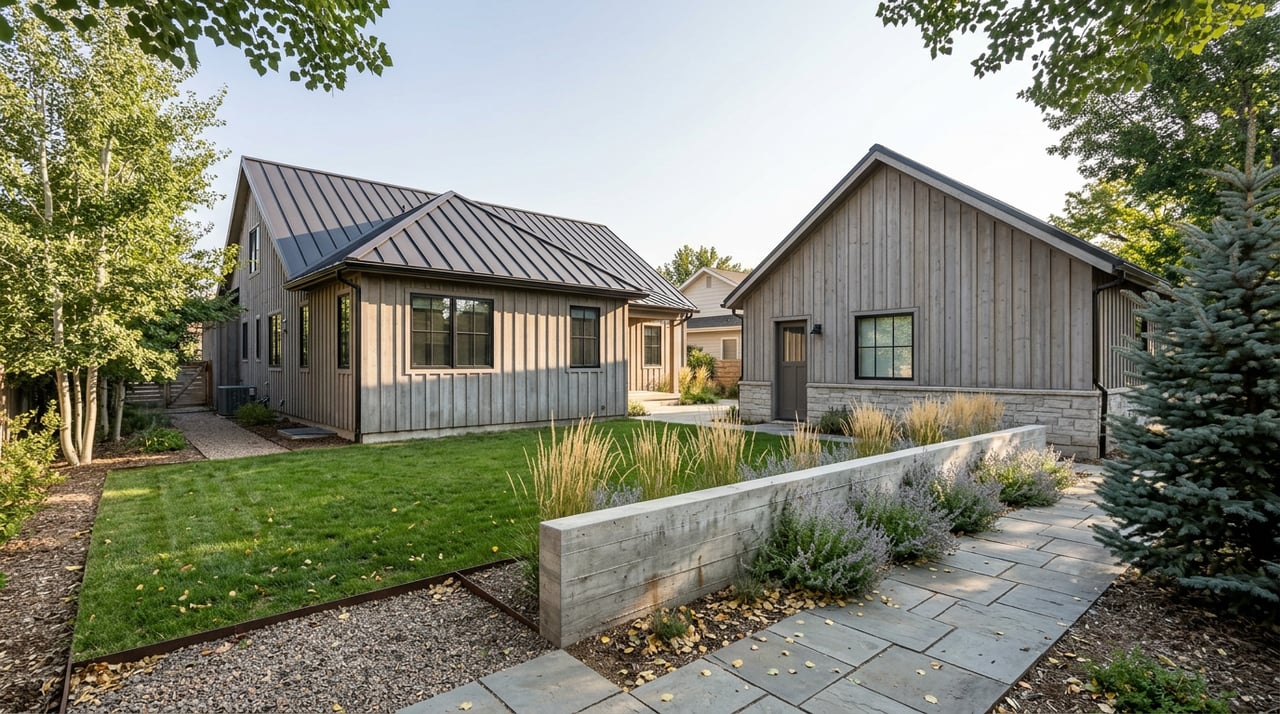
Practically, that means a homeowner or buyer can now add a detached unit on most single-family lots without living on-site, without adding a parking spot, and without the lot meeting a minimum size threshold that used to disqualify smaller parcels. Construction costs for a market-rate detached unit currently run in three rough tiers: a small studio-style unit lands around $200,000 to $240,000 all in, a full one-bedroom with a real kitchen and bathroom runs $260,000 to $300,000, and a two-bedroom family-sized unit runs $360,000 to $420,000. Long-term rents for those units currently land in the $1,650 to $1,900 range for a one-bedroom, higher for larger configurations, and Boulder's own ADU guide confirms owner-occupancy is no longer required as of March 2025.
Activity has concentrated in specific pockets for specific reasons. North Boulder, Newlands, and Gunbarrel have seen the most ADU permit volume, largely because their lots are big enough to accommodate a full detached unit without tripping setback or floor area limits. Whittier and Mapleton Hill sit on the opposite end, with smaller historic lots and design-overlay requirements that add real time and cost to any project, pushing most activity there toward the smallest studio tier rather than a full second dwelling.
What This Means If You're Comparing Boulder to Somewhere Else
The headline you probably saw when Boulder repealed its growth cap implied a market about to loosen. The land constraints that actually govern supply here didn't move an inch, and the price data through 2026 backs that up. If you're choosing between Boulder and a neighboring Front Range town on the assumption that policy reform is about to bring prices down, that's not the mechanism at work.
What did change is smaller, more specific, and easy to miss if you're only comparing median prices across cities. A Boulder lot with genuine ADU potential now carries value that most automated valuation tools and even some appraisers haven't fully caught up to, because the rule change is barely a year old in practice. For a buyer thinking about long-term income potential, or a seller sitting on a larger lot in North Boulder or Gunbarrel, that gap between what the property is worth today and what it can generate once a second unit is built is where the real opportunity sits right now, not in waiting for a supply-side policy reversal that already happened without changing much of anything.
FAQ
Does the 2024 repeal mean Boulder will approve more new homes going forward? Not directly. City officials said the ordinance hadn't been limiting growth for years before it was removed, so its repeal mainly brought the code in line with state law rather than opening new capacity.
Can I build an ADU on any single-family lot in Boulder now? Most single-family lots qualify under the 2025 reforms, since minimum lot size and owner-occupancy requirements were both eliminated. Setbacks, floor area limits, and historic overlay rules still apply depending on the neighborhood.
Is Boulder's median home price actually rising or falling in 2026? Different trackers disagree on direction over the same recent period, which is common in a market this size with relatively few monthly transactions. What's consistent across every source is that Boulder's median sits well above both Boulder County and the Colorado statewide figures.
Where is ADU construction happening most right now? North Boulder, Newlands, and Gunbarrel lead in volume due to larger lot sizes, while Whittier and Mapleton Hill see smaller, studio-tier units due to historic district design requirements.
If you're weighing a move to Boulder, or you're already here and trying to figure out what a lot with ADU potential is actually worth in today's market, Laura Melquist can walk through the specific numbers for your address. Book a free consultation to get a read on your property that accounts for what's actually changed and what hasn't.