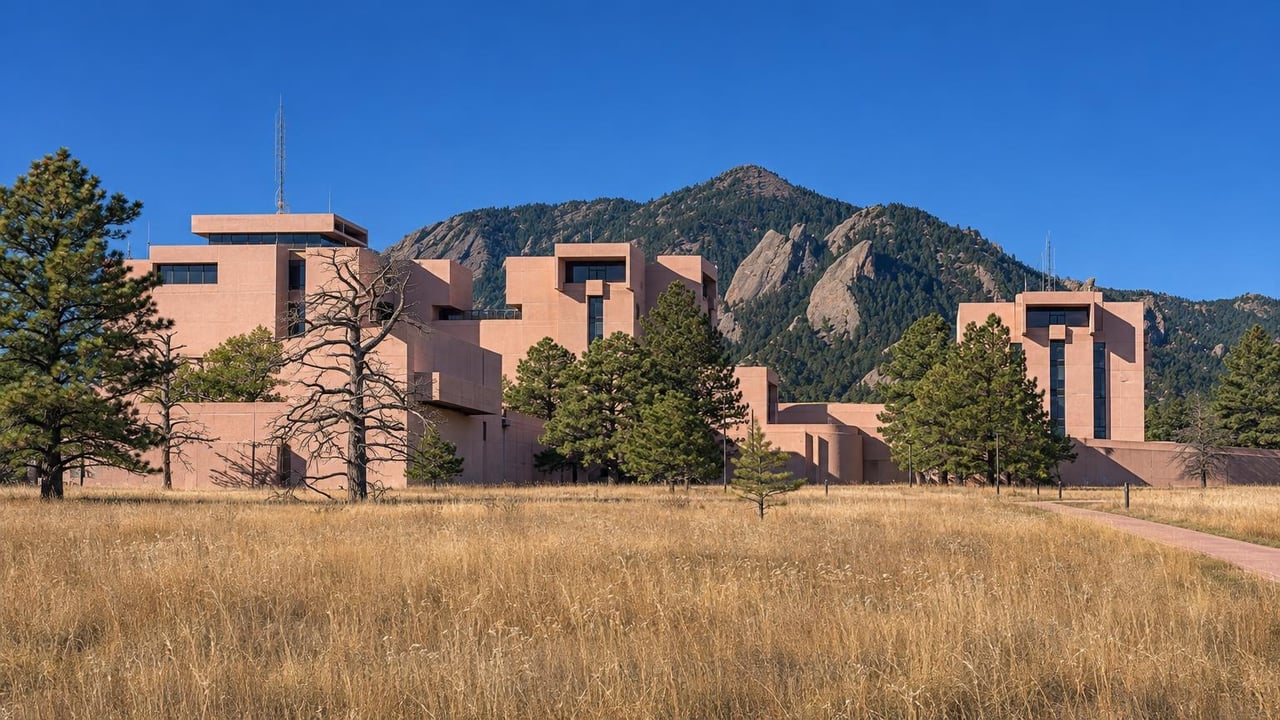
When I.M. Pei took the commission for the building at the top of Table Mesa, he spent a lot of time simply being on the mesa. NCAR's own archives describe him hiking it at all hours, watching the sun hit the rock, sitting among the grazing deer, picnicking up there and camping overnight. Then he and his wife rented a car and drove from Albuquerque to Boulder, stopping at Native American settlements along the way. At Mesa Verde he found the idea he wanted. The archives call the result "the pink NCAR towers." The concrete uses aggregate from a nearby quarry, and its color comes from sand ground out of that same stone, with no commercial pigment.
That building has been at the center of a national fight for almost a year. It is also still free to walk into on most days of the year. If you have family in town this week, or you have driven past the turn onto NCAR Road for years without going up, here is how a visit works now, and why the building is up there at all.
Boulder voters put it on the mesa
NCAR was created in 1960. As Boulder Reporting Lab tells it, Boulder was chosen for its university ties and its growing science community, and the site picked for the lab was the open mesa above town. In 1961 the building went to Boulder voters, who approved a ballot measure for it with nearly 80% of the vote. NCAR's archives call that margin a "resounding endorsement of the organization." Construction started in 1964, and the building was dedicated in 1967.
The city has stayed in NCAR's corner. In February, city spokesperson Sarah Huntley told Boulder Reporting Lab that Boulder was focused on "joining with partners to advocate for NCAR to remain the incredible asset it is."
Where things stand as of Thanksgiving week
The federal fight over NCAR has moved through announcements, a solicitation and two lawsuits. Here are the main dates:
- On Dec. 16, 2025, White House budget director Russ Vought posted that the administration would break up NCAR. CPR News covered the Dec. 20 Boulder protest that followed, which drew hundreds of people along with Rep. Joe Neguse and Sen. John Hickenlooper.
- On Jan. 23, 2026, the National Science Foundation issued a Dear Colleague Letter asking for proposals that included private or public ownership of the Mesa Lab. The same week, Boulder Reporting Lab reported that Congress had passed a funding bill without NCAR-specific protections.
- UCAR, which manages NCAR, filed suit on March 16 and filed an amended complaint on Aug. 26. On June 1, the Colorado Sun reported that a federal judge had blocked the transfer of the NCAR-Wyoming Supercomputing Center.
- On Aug. 20, the Environmental Defense Fund filed a separate suit that, as Boulder Reporting Lab reported, asks the court to prevent the closure of the Mesa Lab.
- On Sept. 24, the government filed a motion in the UCAR case. In it, NSF said it intended to retract its December letter and to issue a new letter superseding the January solicitation. UCAR's deadline to respond was extended to Nov. 16.
- On Nov. 9, UCAR announced that Gretchen Mullendore had been named interim NCAR director, replacing Everette Joseph, whose last day was Nov. 13.
Meanwhile, UCAR still describes itself as managing NCAR on NSF's behalf. The visitor program is still running, and the building is still open to the public.
Getting up the hill
The Mesa Lab Visitor Center is at 1850 Table Mesa Drive. Admission is free, and you don't need a reservation. It is open 363 days a year, 8 a.m. to 5 p.m. on weekdays and 9 a.m. to 4 p.m. on weekends and holidays. The two closed days are for annual maintenance, one in spring and one in fall, and they are announced well in advance. Over a holiday weekend, check the NCAR alerts page before you drive up.
No bus goes to the building. The road climbs 433 feet over 1.3 miles from the neighborhoods below. The closest stop is Table Mesa Drive and Yale Road, which leaves a 2.1-mile walk with 610 feet of climbing. There is also a three-quarter-mile trail from the neighborhoods. Parking is free in the visitor lot on the northeast side of the building. The ramped driveway to the front doors has three ADA spaces, and the main lot has ten more.
What's inside now
NCAR's exhibit page sums up the visitor center in one line: "Touch a cloud, consider chaos, steer a hurricane, take a look at the Sun, and browse art-science galleries." The biggest change in recent years is Sun-Earth Connections. The original version opened in 2010. UCAR evaluates its exhibits every 10 years, and its science education staff spent three years rebuilding this one with solar scientists from NCAR's High Altitude Observatory.
The refreshed exhibit includes a tactile Sun you read with your fingertips, an aurora you can create yourself, and a touchscreen game where you prepare infrastructure for an incoming solar storm. Its "The Sun Today" display shows live solar images from NCAR's Mauna Loa Solar Observatory and NASA's Solar Dynamics Observatory. Kids who have outgrown the usual museum circuit tend to like this one, and so do grandparents.
The free walk-in noon tours run Wednesdays and Fridays from noon to 1 p.m., except on federal holidays. Guides meet visitors in the lobby and talk through current research at NCAR. Monday tours have been dropped. Visitor center staff are on site only during weekday business hours, so a weekday trip gets you more of the building's people along with its exhibits. Groups of 10 to 30 can book a private tour with at least three weeks' notice, so families planning a December reunion need to book soon.
UCAR's Center for Science Education, which runs the exhibits, named Julie Malmberg its director on Nov. 2. The Mesa Lab's family fixture, Super Science Saturday, has happened every year since 1996 and was scheduled for its 30th anniversary on Nov. 7.
The trailhead in the parking lot
The Mesa Lab lot is also a City of Boulder trailhead, and it stays open from 5 a.m. to 11 p.m., long after the exhibits close. The shortest walk is the Walter Orr Roberts Interpretive Trail, which NCAR calls its outside weather trail. From the same lot you can reach the Mesa Trail, Bear Canyon, Bear Peak, Fern Canyon, Skunk Canyon, South Boulder Peak and Wood's Quarry.
If you're bringing a dog or a bike, read the city's NCAR trailhead page and the signs at the trailhead before you set out. The only restrooms are inside the building, so they close when the building does, and there are no picnic facilities. The city lists black bears and mountain lions in the area, along with coyote, fox, mule deer and raptors. The deer Pei sat among are still around.
Mallory Cave appears on the trail list, but the city has closed the cave itself to people permanently. Its closures page lists current closures across the system.
That gives you a solid half-day with guests: an hour in the exhibits, the interpretive loop past Pei's towers, and a stretch of Mesa Trail, all from one free parking spot. If you're mapping winter trail options elsewhere in town, our notes on Boulder's seasonal open space changes and the CU Boulder South closure cover the rest of south Boulder.
At Luxe Realty Group, we think places like the Mesa Lab are part of what living in south Boulder actually means, beyond what shows up in a listing. If you're weighing a move, or deciding what your home near Table Mesa is worth, book a free consultation and we'll talk it through, with the Boulder neighborhood guide close at hand.